Menu

Wednesday, 21 November 2018

વ્યક્તિ વિશેષ,યુવક મહોત્સવ 2018


ઉખડેલા આંબા ન ઉગે,
ઘરે ઉગેલા આભે પુગે...(શ્રીધરાણી)

Some people are like an iceberg,
only one-tenth of their personality would be visible. 

I am talking about

the person who worked hard for cultural events in the past. That's why the title of our various stage name was inspired or given by their name in Youth Festival, Mahendrasir Parmar gave this 'Title Idea' to cultural committee. I made my blog on that great artists.


Krishnalal Shridharani

Krishnalal Jethalal Shridharani was born in Umrala near Bhavnagar on 16 September 1911. He was an Indian poet, playwright, and journalist. He was writing many things same flaw with Umashankar Joshi but after some time he went America for study so he started to work in other field. He went to US for further studies on the advice of James Pratt and Rabindranath Tagore, which made a lasting impression on his attitude.


Education
Primary Education - Umrala
Secondary Education - Dakshinamurti Vinaymandir Bhavnagar

He joins Gujarat Vidhyapith in 1929 but didn't finish (joined Freedom Moment)

Graduation - Shantiniketan (1933) (Visva-Bharati University)
M.A. Degree - New York University with Sociology and Economics(1935)
MS- Graduate School of Journalism, Columbia University. (1936)
Ph.D. -  Columbia University with Sociology and Political Philosophy.
            
               He started writing for Amrita Bazar Patrika in 1945 and returned in India in the year 1946 and he started work as a journalist. He presided over the history and economics department of Gujarati Sahitya Parishad in 1946. He Considered the best journalist of India and America. He had a good relation with Jawaharlal Naheru at that time when he was working in Delhi. He worked with the Ministry of External Affairs for some time. He had wide-ranging contacts and was very friendly with a lot of leaders including Nehru, Mrs. Indira Gandhi, her husband, Phiroze Gandhi, and Dr. S.Radhakrishnan, as also a host of foreign dignitaries.

Works

Sixteen plays.

1) Vadlo (a children's play) (1931),
2) Peela Palash (1934),
3) Piya Gori,
4) Dusku,
5)Dungali no Dado,
6) Sonpari,
7) Vijali,
8) Vrushal,
9) Mor na Inda are his other plays.
10) Padmini is a historical play.

First Poetry Collection

 Kodiya (1934)

Short story

Insan Mita Doonga
based on his experiences with inmates during imprisonment.

Books


My India, My America (1941)

His original works in English include My India, My America (1941) which is about his experiences during his life in the US.


War without Violence

His book War without Violence had a great impact on the American civil rights movement


Warning to the West (1943)


Other Works
The Big Four of India (1941),
The Adventures of the Upside-Down Tree (1959),
Story of The Indian Telegraph (1953),
The Journalist in India (1956),
Smiles From Kashmir (1959)
The Mahatma and the World ( 1946). 

He contributed in several journals and newspapers including The New York Times and Vogue.

He married Sundari, artist daughter of noted Sindhi writer, philosopher, and nationalist, Dayaram Didumal, in March,1950. He was named for the Ranjitram gold medal for services to literature. Krihsnalal died unexpectedly on 23 July 1960, when he was hardly 49.

Khodidasbhai Parmar
(Jamini Roy Of Gujarat)


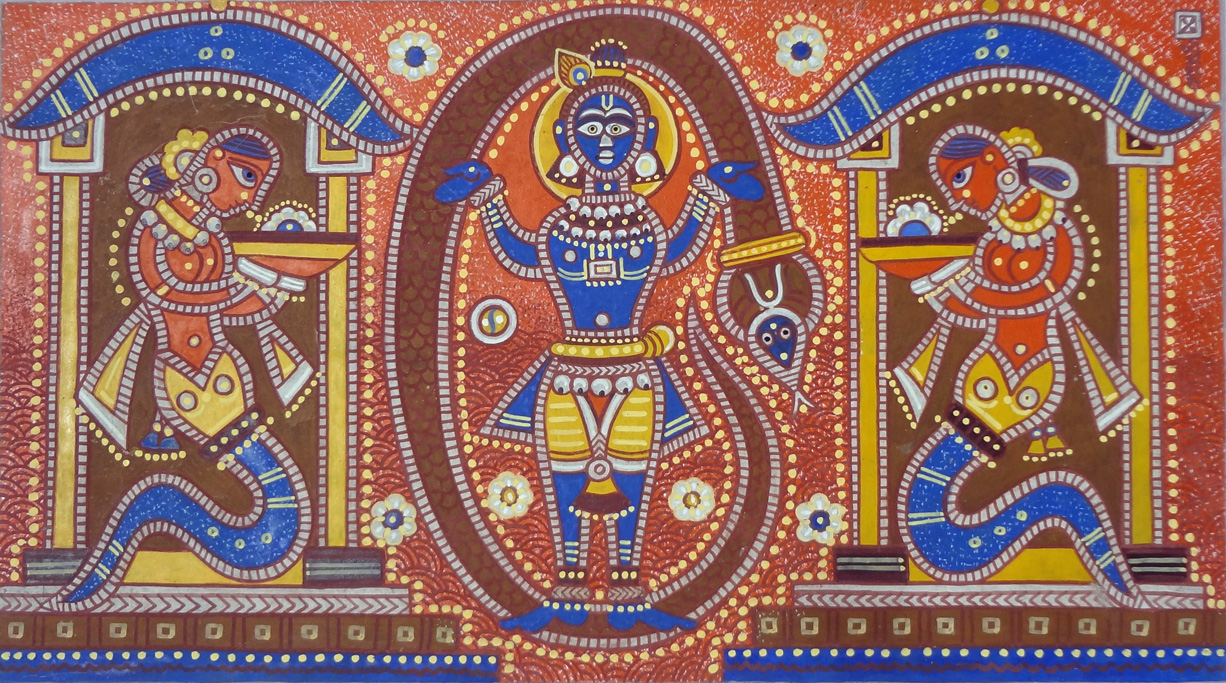
            He is considered as a Jamini Roy Of Gujarat.Jamini Roy is from Bengal. In India about folk paint art Jamini Roy is on top level.  As it is in the Folk Paint Art (Lok Chitra Kala) Khodidasbhai Parmar is on Top in Gujarat. He trained in art by Guru Somalal Shah.


Education

SSC - Bhavnagar (1951)
MA - Shamaldas (Gujarati,Sanskrit)


He was a lecturer at the V.A.M.C. College in Bhavnagar in Gujarat. He also wrote and published several award winning books on the region like the Folk Embroidery of Saurashtra, Gujarati Folk Tales Collection and Krishna: Legend in Gujarati. 


His works are a part of several permanent collections like the Museum of Modern Art and National Art Gallery, both in New Delhi.
Khodidas Parmar passed away in March 2004.

Kiritsinhji Gohil

He was Personal Secretary of our Maharaja Saheb (Krishnakumarsinhji).He was son of Colonel Joravarsinhji. Joravarsinhji was Colonel of Bhavnagar Royal Army Troop. Our one troop of soldier gone in Germany during world warr time. At that time Balaad (Rasda) written in our Bhavanagar.

Few Lines-
"Jorubha bapu Jarmar jitine vela avjo."

Kiritsinhji wrote various script of drama at that time. Royal Family also helps a lot to female artist for present drama in state. They got good place and good property and costumes for drama with high quality budget. Drama troop was getting all facilities for Drama at that time.


These photos are proof of that richness of art.


Rasiklal Andhariya
(Classic voice of Bhavnagar)


Rasiklal Andhariya and Yashvantrai Purohit both is considered best classical singer of our cultural city Bhavnagar.


I heard that they both were student of Omkarnathji


Kalaguru Dharamshibhai Shah

(Oldest teacher of classical dance)


            Dharamshibhai Shah was born on 5 April 1920, In the age of seven he lost his father, and he lost his supportive brother in the age of nighteen. Dharamshibhai came in Bhavnagar from his native place Mandvi. Mulshankar Bhatt given support to settle in Bhavnagar. In the age of fifteen he seen classical dance of Pandit Udayashankar in Bhavnagar and than he attracted to learn rich classical dance form of India. He said in one interview that I want to live my life with Kathak Dance.


Dharamshibhai comleted his studies in Kathak from Gandharv Vidhyalay Mandal in 1963 and was the awarded the Gaurav Purskar by the state government. 


He entered into 

Limka Book of World Records as 

The Oldest Dance Teacher 

at the age of 96 in 2015.


He established 
Kalakshetra Sanstha in 1945 in Bhavnagar 
to teach classical dance. 


He wrote three Books
1) Gujarati,Hindi,English Dictionory
2) Nartan Darshan Part 1 (Discovery of Dance)
3) Nartan Darshan Part 2 (Discovery of Dance)

The Teacher Who 
Passed away with Dance
            
He always said that we have rich culture but why nobody trying to learn and enjoy our rich culture. Indian people given various seven Classical Dance to the world and others are from various country attracted towards our Dance form so it is our responsibility to save our rich culture.

Saturday, 10 November 2018

Activity on Dryden's Essay.


Activity on 
Dryden's Essay


For more information about the task
Click here.

Q 1- Do you find any difference between Aristotle's definition of tragedy and Dryden's definition of play?

Yes there is vast difference between Aristotle's definition of tragedy and Dryden's definition of the play. 


Aristotle says that
"Tragedy is an imitation of an action that is serious and also having magnitude complete in itself...."

and he ended his definition with the word 'catharsis'.

Dryden gives the definition of the play with two new words that is just and live. He says that a play must represent just and lively image of human nature. And he ended his definition with the word 'delight'.

Q 2- If you are supposed to give your personal prediction,
would you be on the side of the Ancient or the modern? 


Upcoming generation is watching scenario from the shoulder of old generation and that's the way they can watch the far than the ancient.

My personal prediction in favor of Modern because as in Essay Eugenius ( Charles Sackville) was in favor of Moderns over the Ancient. It is also true that moderns times imitate things from ancient, but not whole things they imitate. Things are updated with lots of new ideas with knowledge and creation.


Q 3- Do you think that the arguments presented in favor of the
French plays and against English plays are appropriate?


- Some arguments presented in favor of the French plays by Lisideius against English plays are appropriate to some extent.


Example- We can't show Death (Gallows, Murder with Weapon)
- We can't show scenes like Rape, Violence
We can show this but we not able to convince audience 100 % in the scene.

- Some good points about English plays are very lively by nature, it has plot subplots which we do not find in French plays, It makes play interesting. French plays are like lifeless and don't have subplots as well. We can note narrowness of imagination, smallness, too little action in the French play that’s why I found the English play more appropriate.

Q 4- What would be your preference so far as a
poetic or prosaic dialogues are concerned in the play?


It depends on theme on character…but
We can Feel Something Special with Poetic way


I would like to go with poetic dialogues in the play. We are living life in prosaic way that’s way some time we need something extra ordinary and poetic way through we can feel something special, We can find life with poetic way. It is right that there is limitation in dialogue with poetic way but I feel that to use rhyme makes the play more beautiful and live.


Wednesday, 7 November 2018

Thinking Activity: Paradise Lost by John Milton


John Milton


     John Milton was born on 9th December 1608 in London. He studied in Italy, Florencesiena and Rome. He's one of the masterpiece ‘Paradise Lost’ was published in 1667.  John Milton died at home on 8th November 1674.


        Paradise Paradise lost is an epic poem in blank verse by the 17th, Century English poet John Milton. The poem concerns the biblical story of the fall of man.


Q-1. Write a critical note on the character of
Eve.


       As per the spiritual point of view, I have read in Paradise lost book IX that, Eve was made from Adam’s rib. Eve is the first woman and the mother of mankind. She is beautiful, wise, and able, she is superior to Adam only in her beauty.


        When she looks in the water and falls in love with her own reflection, Eve is linked to the flaw of vanity, and Satan as the serpent will use this defect against her. Eve first eats the Forbidden Fruit and then convinces Adam to eat it. Eve is responsible for disobedience and thus Fall of man.


Q.2-Whose arguments did you find more convincing?


    My point of view about that Satan's arguments was more convincing than Adam & Eve because Eve is easily tempted by satan. Satan finds some weak points about Eve, She was weaker than Adam. So satan decides to tempt or deceive her than Adam.

   One weak point was that She was very curious to know about it and that's why she was misled to the tree of prohibition by Satan. Eve also wondered how Serpent could also speak like her, Satan has a more convincing power so Eve easily believed and she convinces to eat the forbidden fruit. So Satan is the most powerful speaker in Paradise Lost and his argument is more powerful in my point of view.


Question 3.
How do you look at divine perspective  in The genesis of the holy bible and human  perspective  in John Milton's Paradise lost book IX?

"The center of literature is human beings."


        As per change of various generation people are also changing with his thoughts so they give his points also different than last generations. If we talk about divine perspective  in the Genesis of the holy bible and human  perspective  in John Milton's Paradise lost book IX than as per my point of view in the holy bible, god was in the center as Ram was believing in Ethics and Krishna was believing in Human-like that Adam and Eve are in the center of john Milton's Paradise lost book IX.

        Literary writers always took the side of human in the past, they can't be on the side of God or religion at the cost of humans. If humans will not live on the earth than who will live? as per holy bible Adam and Eve has to suffer in lots of problems that’s way as a literary writer John Milton has taken the side of humans.

Who knows about god?
but we know about humans…

Monday, 5 November 2018

Depiction of women characters in Kanthapura.


Depiction of women characters in Kanthapura.
Prepared by: Dhaval Diyora
Roll No: 05
Paper – 4: Indian Writing in English
M.A (English):  Sem -1
Enrollment No : 2069108420190013
 Batch:  2018-20
 Email: d.d.diyora@gmail.com
 Submitted to: Smt .S. B Gardi, Department of English, MK Bhavnagar University.
Topic: Depiction of women characters in Kanthapura.


To evaluate my assignment click here


Characterization in Kanthapura

                As the purpose of the novel was to depict a mass-movement and its impact, a highly individualized characterization would have deflected attention from such a depiction. Thus the characters in the novel are not sharply and distinctly individualized. The emphasis is more on themes and ideas rather than on people. Characterization takes a secondary place in Kanthapura, yet it is not without significant and fine characterization.


Women Characters in Kanthapura

                The women characters have been skillfully delineated by Raja Rao. There is a great variety of them in the novel. At the foremost we have Rangamma. She is one of the few educated women in the village. She reads the newspapers herself and thus keeps herself and others acquainted with the day to day developments elsewhere. She knows many things of the general interest of the plants that weep, of the monkeys that were the men we have become, of the worms, thin as dust, worms that get into your blood and give you dysentery and plague and cholera. She told us, too, about the stars which are so far that some have poured their lights into the blue space long before you were born or your father was born...She is a lady who is deferent, soft-voiced, gentle-gestured". She is never be fooled by Bhatta. She helps Moorthy literally, although she does not seem to share his belief that pariahs and Brahmins are all equal. After meeting Sankar, Rangamma develops into a fine leader and speaker. She is able to fill the void created by the death of her father who used to expound the Vedantic texts at Harikatha meetings. It is she who plays the major part in organizing the women of Kanthapura into a Sevika Sangh. She is practical-minded, for when she comes to know that some husbands are complaining that they are not receiving proper attention at home because their wives are away to participate in drill she at once takes proper measures and explains to the Sevikas that they must not neglect their household duties.

                 Next comes Ratna. She is a child widow, who has been powerfully a woman as a matter of shame and inferiority. She is much criticized for her unconventional ways, but she does not care for such criticism. She chooses her own path, and influenced by modern ideas and who does not regard being sticks to it with firmness and determination. She takes keen interest in the Gandhian movement, and is a source of inspiration and help to Moorthy When Jayaramachar, the Harikatha-man is arrested, she conducts the Harikathas. After Rangamma's death, she reads out the newspapers and other publicity material of the Congress for the benefit of the Kanthapurians. When Moorthy is arrested, she carries on his work and serves as the leader. She organizes the women volunteer corps and imparts to the Sevikas the necessary training. She displays great courage and resourcefulness in the face of government repression and police action. She is dishonored, beaten up and sent to jail as a consequence. But she suffers all patiently and unflinchingly When Gandhi goes to England for the Round Table Conference, reaches settlement with the Redman's government and the movement is withdrawn Ratna is disappointed like countless other freedom fighters in India. She goes over to Bombay, and through her letters, we learn of her great admiration for Nehru, "the equal distributionist.
                Achakka, the narrator, though she is never sharply individualized, is revealed by her manner of narration and her comments on persons and events. In the novel, her function is representative and her strength lies in being anonymous. She is just one of the many women of Kanthapura who responded to the call of the Mahatma conveyed through Moorthy. Her faith in the Goddess Kenchamma, her respect for the local scholar Rangamma, her unquestioned affection for Moorthy and her trust in him, all these feelings she shares with other women of the village.
                However, Achakka is a woman with a balanced mind, sound common sense, and the gift of shrewd and intelligent observation. Her personality colors the whole non-cooperation movement, the brave resistance of the people and their consequent suffering. One of the simplest women in the village is poor Narsamma, mother of Moorthy. She cannot understand the ideals dear to her son, but who only knows that she did nothing to deserve the calamity of ex-communication that befalls her family. She is the most pathetic character in the novel.

A Typical Malicious Woman

                Through the character of Waterfall Venkamma, Raja Rao brings out the pettiness, the jealousy, the triviality and orthodoxy of women. Venkamma is a woman of a petty, jealous nature. She cannot bear to see others prosperous or successful. The sight of the happiness of others arouses her wrath and she rails and rails against them. There is no end to her spite, jealousy, and vindictiveness. She is jealous of Rangamma because she has a much larger house and constantly rails against her. She would like to put lizard poison into her food and thus cause her death.
                She is also against Moorthy, because he refused to marry her second daughter. She nurses this grudge against him, and does her best to have her views, she has no sympathy with the Gandhi-movement. She, therefore, sides with Bhatta and the Swami. It is she who spreads the rumor that Moorthy is to be excommunicated. In this way, she causes his mother much pain which ultimately derives her to death. She also hates Ratna for her progressive views and constantly hurls abuses at her. She rails and rails against everybody and thus justifies the nick-name the novelist has given to her.
                However, it is only against her meanness, frivolousness, and conservatism that the character of Ratna shines out Women Presented as Shakti'

Women Presented as Shakti

                In Kanthapura, Raja Rao presents women as various forms of shakti. According to Uma Parameswaran, "Voluble, with an infinite capacity for love and for passing malice, quick to spark into enthusiasm and into cynicism the women of Kanthapura are more human than those created by Raja Rao else-where. They become women at certain times but there is no incongruity between their actions and the author's claim. One realizes that the immanent Shakti rises in every woman at certain pivotal points of life.
                 A typical Indian woman is coy, delicate and submissive, she is also firm as a rock, great in suffering. Shakti rises in them, and each of them is enthused at the proper time. Psychologically prepared for the titanic encounter, they got much inspiration from other examples. It is to be noted that in the last phase of peaceful resistance it is Ratna, a woman, who takes over from Moorthy and leads the Satyagrahis
                "Different forms of Shakti are manifested through the women of Kanthapura. Shakti's indomitable spirit possesses them in their Satyagraha non-violent struggle) against the British government. When the police ill-treat them with their sticks and boots, the women think, move, and act as one for they are more distinct and pervasive in the devotional aspect. Woman as the Eternal Devotee, Shakti kneeling in rapt adoration in front of Siva, reveals herself through them as they listen to Jayaramachar retelling epic stories and to Ramakrishnayya reading passages from the Scriptures. The most touching example of their edifying faith is the narrator's musing on the ruins Kanthapura. She dreams of a happy ending to a modern Ramayana where Rama (Gandhi) will return from his exile (visit to England) with Sita (India) who had been captured by Ravana (the British) and as he returns to Ayodhya Delhi) Bharata (Nehru) who has been reigning as regent, will welcome him and there will be celestial flowers showered upon his aerial chariot."


Reference: